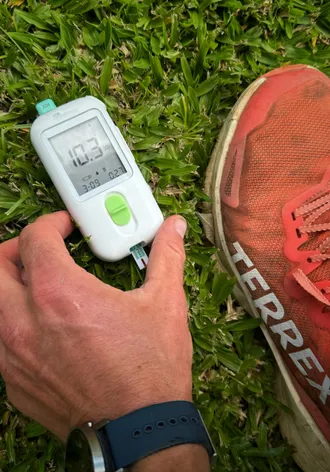
Eaglenos Lactate Analyzer Usage Guide
Preparing the Device
Open the device and insert the batteries. The test strip package will include a special chip — insert it into the top of the device. The chip is made separately for each batch of strips: new package, new chip. It is acceptable not to insert the chip if your previous package was from the same batch (each package is numbered). The chip only needs to be inserted before the first use of new strips; after that, you can remove it or leave it in the device.
Preparing for Training
For training, it is best to place the device in a sealed bag. The strips are the most important element for device accuracy: they should always remain in the container and only be removed during sampling. During training, if the temperature is below +5°C, the data may be inaccurate (see the manual for details). To use the device in cool weather, it should be kept in a bag in a warm place.
For analysis, you will also need lancets to prick your finger or earlobe, as well as alcohol and dry wipes to remove sweat.
Sampling Timing
During training, it is important not to rush. You always have 30–40 seconds in low-intensity zones, at least 1 minute in moderate-intensity zones. In zones above LT2 and during short sprint accelerations, peak lactate is typically observed after 1–3 minutes.
Sampling Procedure
Before taking a sample, it is important to clean your finger of sweat — if sweat mixes with blood, the result will be inaccurate.
If you are sampling yourself, it is more convenient to use your finger. If someone is helping you, blood can be taken from the earlobe.
At the moment during training when you need to take a sample:
1. Stop.
2. Wipe your finger or earlobe with an alcohol wipe, then a dry one (if no alcohol wipe is available, at minimum use a dry one). The finger must be free of sweat.
3. Take out a lancet and a test strip. Insert the strip into the device.
4. Prick the fingertip or earlobe.
5. Gently squeeze out blood — don't press too hard. Wipe the first 1–2 drops with a dry wipe, and take the sample from the 3rd drop.
6. The test strip has a well — it must be completely filled with blood. If there is too little blood or the well is not filled in one attempt, the data may be inaccurate.
7. The strip must be in the device at the moment of sampling.
8. Wipe your finger and wait for the result — 10 seconds.
9. Remove the strip and place the device back in its sealed container.
The blood drop should always be uniform and not spread across the finger — otherwise sweat will contaminate it and the data will be inaccurate.
Handling Test Strips
Strips are the most important factor for result quality. Only handle the strip by its middle section to avoid damaging the electrode. Regardless of which device you use to measure lactate, the most important factors will always be the test strip and proper sampling technique — the devices themselves are quite reliable and rarely malfunction.
How Eaglenos Test Strips Work
Eaglenos lactate analyzer test strips include gold electrodes, which increases the accuracy of analysis results by improving and standardizing the electrical transmission from the test strip reaction zone to the analyzer.
In next-generation biosensors, in addition to the specific enzyme that reacts with the analyte, a mediator is also used for electron transfer.
Electrons are released as a result of the chemical reaction of the studied parameter (in this case, lactate) with a specific enzyme. The more lactate, the more electrons are released — therefore there is a direct relationship between the lactate concentration in the sample and the number of electrons produced, which generates an electrical potential proportional in intensity to the lactate concentration.
The analyzer measures the electrical current generated in the reaction zone. To do this, it uses at least 2 electrodes built into the test strip, which connect the analyzer to the reaction zone (near the test strip tip). Once the analyzer measures the electrical potential, thanks to its own algorithm, it converts the electrical current intensity into a specific lactate value and displays the result on the screen.
Today, the vast majority of researchers working in analytical quality control believe that when it comes to obtaining accurate results with a portable blood analyzer, the most important factor is the quality of the test strip, its preservation, and proper handling — rather than the analyzer itself. Therefore, any contamination from sweat, liquid, or dirt can damage the strip and produce inaccurate results.